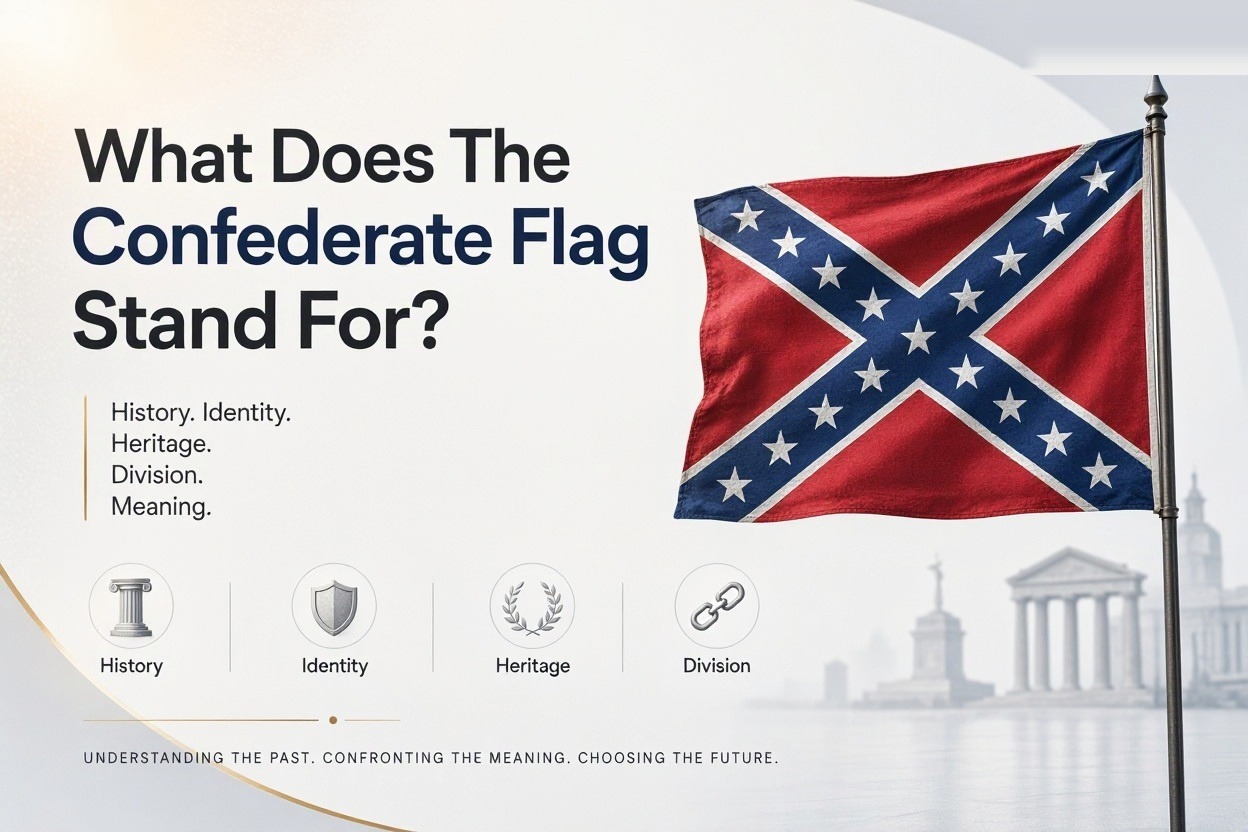
If you ask what does the confederate flag stand for, the short answer is that it means very different things to different people. For some white Southerners it honors soldiers and family heritage. For many Black Americans and historians it represents slavery, secession to protect slavery, and later use to oppose civil rights.
That split did not happen by accident. The flag most people picture today was never the official national flag of the Confederacy. It was a battle flag carried by the Army of Northern Virginia. Over time politicians, protest groups, pop culture, and private citizens gave it new layers.
This history matters because the symbol still shows up on trucks, T shirts, porches, statehouse grounds, and in heated debates. To get past slogans, you need dates, documents, and plain context. That is what follows here.
We will look at Civil War roots, postwar memory, Jim Crow use, the 1940s revival, and present-day law and culture. You will also get clear facts to help you talk about it with accuracy.
Civil War Origins and the Battle Flag Design
The Confederacy used three different national flags between 1861 and 1865. None of them is the familiar blue X with white stars on red. That design began as a square battle flag to avoid confusion on smoky battlefields. Soldiers needed a bold mark that did not look like the United States flag.
General P G T Beauregard pushed for a distinct battle emblem after First Manassas. The result was the Southern Cross, a blue saltire with white bordered stars. Artillery units, infantry regiments, and later naval forces used versions of it. Troops carried it for identification, not as a political platform by itself.
What the Stars and Bars Really Were
The first Confederate national flag was called the Stars and Bars. It had three horizontal bars in red and white with a blue canton of stars. Citizens flew it from public buildings and homes. On the battlefield it caused deadly mix ups because it resembled the Union Stars and Stripes at a distance.
Confederate Naval Jack Versus Battle Flag
The rectangular version most Americans know today comes closer to the Confederate naval jack and the later battle flags of Tennessee and Virginia units. Flag makers produced many sizes and shades. After the war, veterans groups standardized the rectangular red form for parades and memorials. That choice shaped public memory.
Heritage Claims in Southern Communities
For many families in Mississippi, Alabama, Georgia, South Carolina, and Virginia, the flag links to grave sites, reunions, and stories about great grandfathers who fought. United Daughters of the Confederacy chapters placed flags on monuments between 1890 and 1920. They framed service as brave, loyal, and tied to home defense.
Church homecomings, country music, stock car racing, and high school mascots later picked up the image. In those settings people often say it honors grit, rural pride, and resistance to outside control. That feeling can be sincere at the personal level even when the wider history is painful.
How Family Stories Shape Views
Oral history is powerful. If you grew up hearing that your ancestor owned no enslaved people and fought because his state was invaded, you may attach honor to his flag. Letters and pension records support that many poor soldiers fought for pay, loyalty, food, or pressure. Broader war aims, though, were set by political leaders.
Key Points Often Raised by Heritage Supporters
1. Many Confederate soldiers did not own enslaved workers and saw themselves as defending homes.
2. Memorial use after 1865 focused on grief, burial, and veteran care rather than policy.
3. Regional pride, music, and sport later separated the image from government action for some fans.
4. Removal of markers can feel to supporters like erasing local dead rather than judging slavery.
5. Private display on land or clothing is still protected speech in most cases in the United States.
Slavery and White Supremacy in Confederate Documents
Historians point to secession papers because they state motives in plain words. South Carolina, Mississippi, Texas, and others wrote declarations that named slavery and white supremacy as central reasons for leaving the Union. Mississippi said its position was thoroughly identified with the institution of slavery.
Confederate Vice President Alexander Stephens gave the Cornerstone Speech in March 1861. He said the new government rested on the claim that Black people were not equal to white people and that slavery was their natural condition. That speech is hard to square with claims that the war had nothing to do with bondage.
What Soldiers Actually Fought For
Motives varied by rank and place. Rich planters feared loss of property in human beings and political power. Yeoman farmers feared draft law, debt, and invasion. Enslaved men and women sought freedom and often fled to Union lines. Union soldiers fought at first to preserve the nation, then after 1863 also to end slavery.
Reading Original Records With Care
Anyone can check state secession ordinances, newspaper editorials from 1860, and the Confederate Constitution. The latter protected slavery by name and barred any law impairing the right of property in enslaved persons. Personal bravery in battle and a cause rooted in human bondage can both be true at once.
Use During Reconstruction and Jim Crow Laws
After 1865, federal troops left the South and white Democrats regained control. Between 1877 and the 1960s, states passed poll taxes, literacy tests, and segregation codes. Lynching enforced racial terror. During this period Confederate emblems returned to courthouses, capitol domes, and school names to signal who held power.
Veterans reunions kept battle flags in a mournful setting. At the same time, groups like the Ku Klux Klan marched with robed crosses and sometimes with Confederate style banners. That double use blurred mourning and intimidation. For Black residents, the message on a courthouse lawn was clear and cold.
Timeline of Public Symbol Use
1865 to 1877 – Mainly funerals, cemeteries, and veteran aid meetings. Battle flags draped coffins and marked graves.
1878 to 1915 – Monument boom financed by states and ladies groups. Flags carved in stone and raised on poles.
1915 to 1940 – Film, college football, and advertising spread the rebel image to national youth culture.
1948 to 1968 – Political campaigns and state flags adopted the emblem during fights over segregation.
Comparison of Memorial Versus Political Use
Memorial setting – Cemetery services in Richmond, Vicksburg, and Gettysburg. Focus on names, dates, prayers. Audience mostly descendants and local residents.
Political setting – State capitols, campaign rallies, and courthouse rallies. Focus on states rights and opposition to integration. Audience included lawmakers, press, and organized crowds.
Classroom and museum setting – Display with labels, dates, and documents. Focus on evidence and multiple voices.
This split helps explain why context changes meaning so much.
Second Life in the Civil Rights Era
The modern fight over the flag reignited in 1948. The States Rights Democratic Party, called Dixiecrats, ran Strom Thurmond for president on a pro segregation platform. Supporters waved Confederate battle flags at rallies in Birmingham and elsewhere. From that point the banner was tied in news photos to defense of Jim Crow.
In 1956 Georgia changed its state flag to include the battle emblem. In 1961 South Carolina raised the battle flag over its capitol dome to mark the Civil War centennial and kept it flying through the civil rights years. Supporters cited heritage. Critics saw a snub to Black citizens seeking voting rights.
Media Images That Locked In Meaning
Television brought confrontations at lunch counters, schools, and bridges into living rooms. When counter protesters held rebel flags while marchers demanded the vote, viewers linked the two for good. Later movies like The Dukes of Hazzard added a fun rebel car top, yet news footage kept the harder link alive.
Why the 1960s Still Drive Debate
People who lived through school integration remember exactly which flag flew at their courthouse. That lived memory passes to children and grandchildren. Even if a young driver today means no harm by a bumper sticker, older neighbors may read it through those years. Time does not erase that link.
Modern Meanings Across Different Groups
Today the flag works like a mirror. Some rural white teens use it to say country pride, hunting life, and loyalty to friends. Some bikers and rock fans use it as a rebel pose. White nationalist groups use it to claim racial purity and threaten others. Black Southerners often read it as contempt for their freedom.
Surveys show sharp gaps by race, age, and region. White Southern respondents are more likely to call it pride. Black respondents in all regions are far more likely to call it racism. Veterans, teachers, pastors, and coaches often fall in between and stress setting, intent, and respect for others.
Practical Tips for Reading Intent and Impact
Tip 1 – Look at place. A museum case with a label is not the same as a pickup truck circling a protest.
Tip 2 – Look at pairing. A flag next to civil rights photos invites study. The same flag next to slurs or weapons signals threat.
Tip 3 – Listen to local voices. Ask long time residents how that exact display has been used in that town.
Tip 4 – Check timing. Raising the banner during a vote on school policy or policing carries political weight.
Tip 5 – Note response to requests. Willingness to move a private display from a shared workplace shows care.
Legal Battles Over Public Display
United States law treats private and government speech in different ways. On your own truck, shirt, porch, or tattoo, the battle flag is generally protected expression. Employers, schools, and event hosts can still set dress and conduct rules for safety and order.
Government display faces stricter review. Courts have ruled that license plates, city seals, and flags on capitol poles can imply official backing. After the 2015 Charleston church shooting, South Carolina lawmakers voted to remove the battle flag from capitol grounds. Mississippi voters approved a new state flag without the emblem in 2020.
What Courts and Schools Usually Allow
Private citizens on public sidewalks can carry the flag in protest under free speech rules. Police can still act against threats, fights, or blocked traffic. Public schools can limit disruptive symbols under Tinker and later cases if leaders show real risk to learning. Private firms and sports leagues can ban it outright on their property.
Limits People Often Miss
Free speech does not force a store to sell the item. It does not force a school to allow it in class. It does not protect true threats, harassment at work, or vandalism. Homeowner groups may also limit flag poles by contract. Always read local policy before assuming a right to display anywhere.
Comparison With Other Historical Symbols
Critics of removal often ask why other flawed figures stay honored. Supporters of removal answer that the Confederacy lasted four years and existed to break the nation to keep slavery. That record differs from a long national flag that flew during both slavery and emancipation.
A fair comparison looks at purpose, length of use, and present harm. The United States flag flew over slavery, yet also over the Thirteenth Amendment, Black regiments, and civil rights laws. Nazi and KKK emblems were built for racial rule from the start. The Confederate battle flag sits closer to the second group in origin and later use.
How Other Countries Handle Painful Banners
Germany bans public display of Nazi flags outside study, art, or teaching. South Africa limits use of old apartheid era flags for hateful purposes after court rulings. Britain allows many historic ensigns but councils can remove them from town halls after local votes. The United States leans more toward private rights plus local choice for public land.
Steps to Research Any Flag You See
1. Photograph the exact design, since many rebel variants exist and details matter.
2. Note the place, date, and event where it flies to capture context.
3. Search town council minutes and newspaper archives for when and why it went up.
4. Read secession documents and unit histories tied to that county or regiment.
5. Ask a librarian, archivist, or museum curator to confirm sources before sharing claims.
How Schools and Museums Teach the Symbol Today
Good teaching puts the flag inside a full story rather than hiding it. The Smithsonian, Gettysburg, and the American Civil War Museum in Richmond display battle flags with labels about who made them, who carried them, and who suffered under the cause. Students can face hard facts without being shamed for asking questions.
Classroom rules vary by state. Some standards name slavery as the central cause of secession. Others stress states rights and tariffs more. Parents can help by asking for primary sources. Letters from soldiers, ads for slave auctions, and pension files give a human view that textbooks sometimes flatten.
Related Terms That Cause Confusion
Rebel flag often means the rectangular battle flag on cars and shirts. Southern Cross points to the blue X design itself. Stars and Bars refers to the first national flag, not the battle flag. Dixie flag is a pop term with no official status. Lost Cause refers to the postwar story that the South fought nobly for rights rather than slavery.
Common Classroom Mix Ups to Avoid
Do not call the battle flag the national flag of the Confederacy. Do not claim tariffs alone caused secession when state papers stress slavery. Do not treat all Southerners as one block, since about four in ten Southerners were Black and many white Southerners stayed loyal to the Union. Precision builds trust.
Talking About the Flag With Care
Conversations on this topic burn out fast. Start with shared facts, not labels. Say what you saw, where you saw it, and how it landed. Invite the other person to share family or community ties. Keep the focus on actions and policies rather than judging worth as a person.
At work or school, follow written policy and report threats right away. Do not pull down someone else display or block traffic to make a point. If you manage a team, post clear rules that apply to all symbols, give reasons tied to safety and service, and enforce them with steady calm.
Troubleshooting Tough Conversations
If talk stalls on heritage claims, bring up secession papers and the Cornerstone Speech as direct evidence. If talk stalls on racism claims, allow room for grief over war dead and rural identity. If tempers rise, pause and agree to check one source each before meeting again. If harassment is involved, stop debate and use formal reporting tools.
Conclusion
Debate over this banner will not fade soon because it touches family, race, region, and power in one image. Facts alone will not settle feelings, yet they can steady public choices about capitols, schools, and memorials. Careful context lets mourning continue without forcing official honor that wounds fellow citizens.
Anyone still asking what does the confederate flag stand for should weigh battle history, secession records, Jim Crow use, and present harm side by side. With that record in view, communities can choose displays that teach truth, guard dignity, and leave room for shared civic life.
Frequently Asked Questions
Reasons Some People Still Display the Confederate Flag?
Some holders cite ancestors, Southern pride, rural life, or rebel style. Others use it to oppose federal power. Many do not link personal use to slavery, while critics note the wider record ties the image to bondage and segregation.
Status of Bans on the Flag in Public Places?
No nationwide ban exists for private use. Governments can remove it from capitols, seals, plates, and schools under set rules. Private firms, leagues, and schools often bar it on their own grounds for safety and order.
Difference Between the Battle Flag and the Stars and Bars?
The Stars and Bars was the first Confederate national flag with red white bars and a blue canton. The battle flag used the blue saltire on red for field ID. The rectangular battle form seen today grew famous later.
Meaning of the Flag to Many Black Americans?
Many Black Americans view it as a mark of slavery, lynching threats, and school segregation fights. News photos from the civil rights era cemented that view. Even quiet display can feel hostile in shared spaces.
Best Ways to Learn the Full History Nearby?
Visit county archives, battlefields, and civil rights museums for local records. Read secession papers, soldier letters, and town minutes. Ask curators and librarians for guides tied to your state and county.