
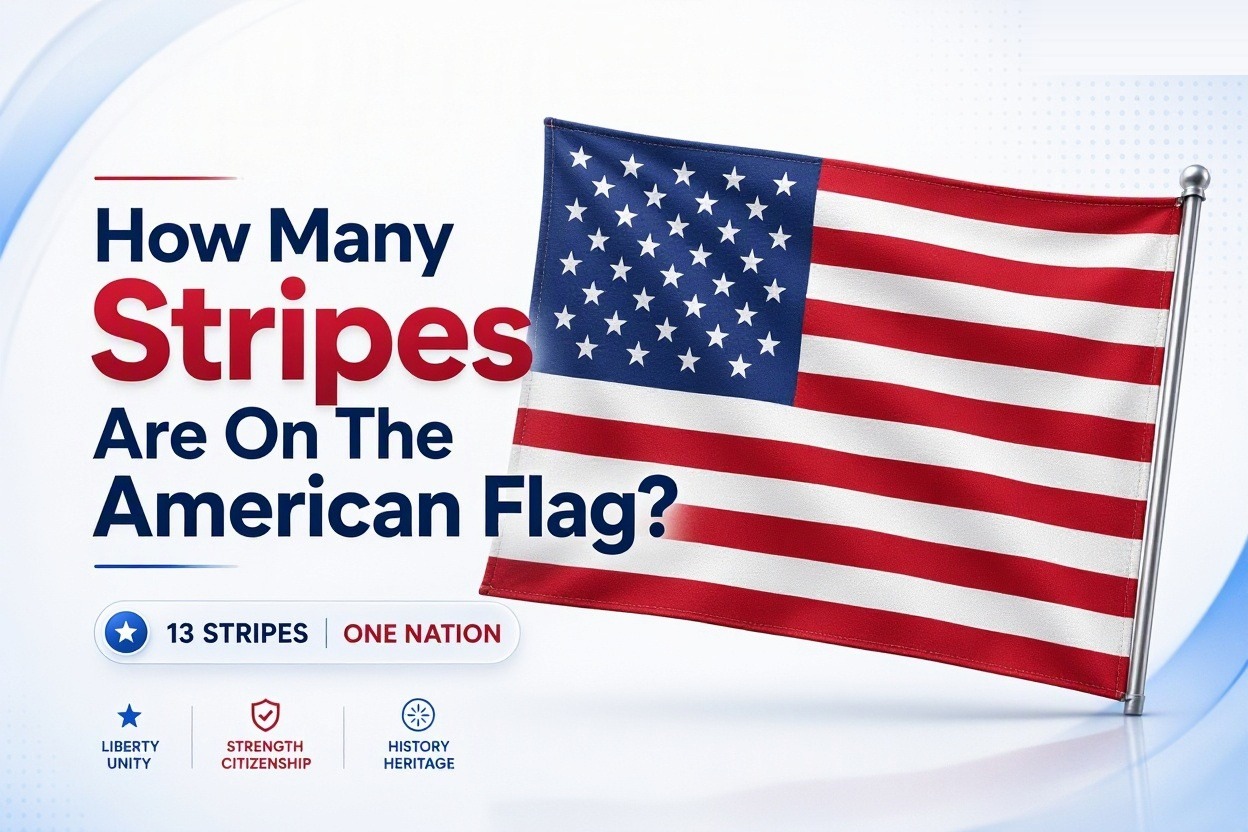
There are thirteen stripes on the American flag, arranged in seven red and six white horizontal bands. Anyone researching how many stripes are on the american flag will find the same consistent answer across history books, classrooms, and federal specifications. The count has remained stable for more than two centuries.
That stripe total honors the thirteen British colonies that declared independence in 1776 and formed the original United States. While stars have been added for every new state, the stripe number was fixed early to preserve that founding story. It keeps history visible in daily life.
You will see this design on schools, post offices, stadiums, military bases, and front porches across the nation. The thirteen bands run from the top edge to the bottom edge, starting and ending with red. That pattern helps with quick visual counting and official reproduction.
In this guide, we break down what those stripes mean, why the number stopped changing, how colors are defined, and how to count, teach, display, and care for the flag. You will also get comparisons, troubleshooting tips, and practical facts for home, school, and travel use.
Quick Answer on the Stars and Stripes Count
The current United States flag carries thirteen horizontal stripes and fifty white stars on a blue canton. The stripes represent the founding colonies, while stars represent current states. That balance links origin and growth in one recognizable national symbol for citizens and visitors alike.
Federal law and military specifications confirm the layout, order, and proportions used by licensed makers. Seven red stripes alternate with six white stripes, beginning and ending with red at the outer edges. The canton covers the upper left and spans the width of seven stripes.
If you are counting from a photo or a porch, start at the top red band and move down one by one. Many people lose track near the blue field because the canton covers part of several stripes. Count the visible ends on the right side for better accuracy.
For teachers, parents, and new citizens, the short answer works well in lessons and ceremonies. Thirteen stripes stand for thirteen colonies, fifty stars stand for fifty states, and the design has looked this way since Hawaii joined the Union in 1960 with no later changes.
What Each Stripe Represents in American History
Each stripe stands for one of the thirteen colonies that joined together to seek independence from Britain. Those colonies shared grievances over taxes, trade limits, and political voice, then sent delegates to coordinate resistance. The bands turn that alliance into a lasting visual record.
The colonies were Delaware, Pennsylvania, New Jersey, Georgia, Connecticut, Massachusetts, Maryland, South Carolina, New Hampshire, Virginia, New York, North Carolina, and Rhode Island. Each one later became a state with its own constitution, courts, and elected leaders under the new American system.
The order of stripes does not rank the colonies by size, wealth, or date of settlement. All thirteen bands share equal width and spacing to show equal standing in the cause. That equality mattered to leaders who feared domination by larger or richer neighbors.
Over time, schools began linking stripe lessons to timelines, maps, and primary documents. Students trace each colony on the Atlantic coast, match dates of ratification, and discuss local founders. The flag becomes a starting point for broader study rather than a decoration alone.
The Thirteen Original Colonies Represented by the Stripes
1. Delaware, Pennsylvania, New Jersey, Georgia, Connecticut, Massachusetts, Maryland
2. South Carolina, New Hampshire, Virginia, New York, North Carolina, Rhode Island
3. All thirteen entered the Union between 1787 and 1790 after ratifying the Constitution
4. Each colony contributed soldiers, funds, supplies, or political leadership during the Revolution
5. Classroom tip – assign one colony per student group and match it to a stripe
Why the Stripe Count Stayed Fixed at Thirteen
Early flags added both stars and stripes for new states, which quickly created clutter and production problems. The fifteen stripe flag flown at Fort McHenry showed how crowded the design could become. Congress saw that endless additions would weaken recognition and raise manufacturing costs.
The Flag Act of 1818 fixed the stripe number at thirteen while allowing a new star for each state. That compromise preserved respect for the founding period and left room for national growth. It also gave makers a stable pattern to follow for decades.
Since that decision, every official change has involved stars only, from twenty states in 1818 to fifty states today. Stripe width, color order, and overall proportions stayed consistent through sewn, printed, and digital versions. The result is strong continuity across generations.
This fixed count helps the public remember history without recounting bands after each admission. Children learn one stripe story in kindergarten and keep using it through adulthood. Veterans, immigrants, and visitors encounter the same pattern at ceremonies and federal buildings nationwide.
The Colors and Design Standards of the Stripes
The flag uses Old Glory Red and Old Glory Blue with white stripes and stars, as defined by government color references. Makers match thread, dye, ink, and pixels to those standards for consistency. Shades may look different in sunlight, shade, photographs, or indoor lighting, yet specifications remain constant.
Proportions matter as much as color for a correct appearance. The official ratio is 1.9 in width to 1.0 in height, with thirteen equal stripes stacked vertically. The blue canton extends down through seven stripes and across a set portion of the length. Licensed diagrams show exact measurements.
Materials affect how stripes appear and last over time. Nylon flies well in light wind and dries quickly, polyester resists weather for outdoor poles, and cotton offers a traditional look for indoor display. Printed stripes suit parades, while sewn stripes suit long term ceremonial use.
Home buyers should check stitching, grommets, header strength, and colorfast claims before purchase. Look for reinforced fly ends, double stitched seams, and fade resistance ratings. A well made flag holds stripe alignment after washing, wind, sun exposure, and repeated raising and lowering.
Flag Stripe Layout at a Glance
Top band – red stripe one, fully visible across the width
Alternating pattern – red, white, red, white through all thirteen bands
Canton coverage – blue field overlays upper left across seven stripe heights
Bottom band – red stripe thirteen, fully visible across the width
Proportion check – measure height, divide by thirteen for one stripe height
How the Flag Changed From 1777 to Today
The first national flag resolution in June 1777 called for thirteen stripes alternating red and white with thirteen stars. It did not set exact shades, star shapes, or arrangement patterns. Local makers produced many working versions that shared the same basic stripe count and spirit.
Vermont and Kentucky later brought two more stars and stripes, creating the fifteen stripe banner that inspired the national anthem. That flag flew over Baltimore harbor during a major battle in 1814. Its large size and extra bands made it memorable but hard to reproduce at scale.
After Congress returned to thirteen stripes in 1818, designers focused on star fields instead. Stars moved through circles, rows, diamonds, and staggered grids as states joined. Stripes stayed calm and unchanged while the canton grew denser and more organized with each admission.
The fifty star arrangement adopted in 1960 uses nine alternating rows of six and five stars. It remains the longest serving version in national history. Through all these canton updates, the thirteen stripe base gave citizens a familiar frame that worked on ships, forts, classrooms, and screens.
Shared Elements Across Historic Versions
Betsy Ross style circle – thirteen stars in a ring above thirteen stripes
Fort McHenry style – fifteen stars and fifteen stripes for a short period
Civil War era versions – thirty three to thirty five stars with thirteen stripes
Modern fifty star version – fifty stars in staggered rows with thirteen stripes
Common Miscounts and Display Mistakes to Avoid
Many miscounts happen because the blue canton hides the left side of the top seven stripes. Viewers count only full length bands on the left and reach seven or eight. The fix is to count along the right edge, where all thirteen stripe ends remain visible from top to bottom.
Wrinkles, folds, shadows, and low resolution photos also cause errors. A rippled flag in wind can blend two narrow bands into one thick band from far away. Step closer, pause video footage, or smooth a classroom flag on a table before asking students to count aloud together.
Hanging a flag vertically creates another common error when people read top to bottom incorrectly. For proper vertical display, the canton should appear in the upper left from the viewer perspective. Stripes will then run vertically, but the total remains thirteen distinct bands.
Damaged, faded, or homemade flags may show uneven widths that invite confusion. Replace frayed outdoor flags, clean indoor flags by care instructions, and avoid costume style decorations that merge colors. Use an official specification product for lessons,Photos, and public ceremonies whenever possible.
Classroom and Home Counting Checklist
Stand on the right side of the flag where stripe ends are clear
Start at the top red band and touch or point to each band
Say red, white, red, white aloud to keep alternating order
Confirm seven red bands and six white bands for thirteen total
Check that top and bottom bands are both red as a final test
How to Teach Kids the Stripe Count With Confidence
Start with a large, flat flag or printed image so children can see every band clearly. Place it on a table or floor, smooth out folds, and let kids trace stripes with a finger. Naming colors aloud builds focus and prevents skipping during the first few attempts.
Connect the number thirteen to a story rather than rote memory alone. Talk about thirteen groups of colonists, thirteen signatures on a shared risk, and thirteen new states at the start. Maps, picture books, and short biographies make those abstract bands feel concrete and personal.
Use movement and art to reinforce learning for different ages. Younger kids can color seven red and six white strips, then glue them in order. Older students can measure stripe height, calculate proportions, or compare historic flags. Quizzes work better after hands on practice.
Review often in real settings like assemblies, field trips, holidays, and sports events. Ask children to spot the canton, count stripes from the right edge, and explain what the number means. Repeated short practice builds lasting recall without pressure or lengthy lectures.
Activities That Reinforce the Number Thirteen
Color and glue – cut thirteen paper strips and assemble in correct order
Map match – link each stripe to a colony on an Atlantic coast map
Measure and math – divide flag height by thirteen to find stripe size
Story cards – match founders, dates, and events to colony names
How the American Flag Compares to Other National Flags
The United States keeps stripes as a historical marker, while many countries use stripes for geography, politics, or ideals. Malaysia uses fourteen red and white stripes for its states and federal territories. Liberia uses eleven stripes to recall American settlement history and shared symbols.
France, Italy, Ireland, and Belgium use vertical bands rather than horizontal stripes for their tricolors. Those designs stress unity among regions or political principles rather than a count of founding members. The visual difference helps travelers tell flags apart at international events and airports.
Some flags change stripe counts when politics change, unlike the fixed American total. Libya, Malawi, and South Africa have altered layouts to mark new eras. The United States instead adds stars, which keeps the stripe story stable while still showing growth through statehood.
For collectors, these contrasts show why specifications matter across borders. Stripe width, direction, color codes, and placement all carry meaning. A side by side display works well in classrooms to teach respect, recognition skills, and basic vexillology without oversimplifying other nations.
Stripe Use in Selected National Flags
United States – thirteen horizontal stripes for original colonies, fifty stars for states
Malaysia – fourteen horizontal stripes for states and federal territories combined
Liberia – eleven horizontal stripes recalling eleven signers of its declaration
France – three vertical bands representing liberty, equality, and fraternity ideals
Proper Care and Display Rules for a Striped Flag
Federal custom calls for raising the flag briskly and lowering it slowly with respect. Display it from sunrise to sunset on buildings and poles, or illuminate it properly if flown at night. Position it so stripes hang free without touching floors, water, roofs, or nearby objects.
Weather care protects stripe color and fabric strength over time. Bring lightweight flags inside during storms, high winds, snow, or heavy rain unless made for all weather use. Clean by label directions, mend loose stitching early, and retire worn flags through a dignified program run by veterans groups.
Placement matters during events with other flags, speakers, or audiences. The American flag holds the position of honor at the front, center, or speaker right in most settings. Keep stripes straight, canton high on the left, and lighting even for photographs and broadcasts.
At home, choose the right size for your pole, porch, or wall to keep proportions clear. A flag that is too large will drag, fold, and hide stripes, while one that is too small may look lost. Measure mounting space first, then buy a size that flies freely.
Practical Tips for Long Lasting Stripe Color
Rotate two outdoor flags to reduce sun and wind wear on each one
Rinse salt, dust, and pollen after coastal or desert exposure periods
Store clean, fully dry flags folded in a cool, dry container
Replace frayed fly ends before tearing reaches printed or sewn bands
Related Flag Facts Worth Knowing Next
The Pledge of Allegiance, national anthem, and flag holidays all connect to stripe history in schools and public life. Flag Day on June fourteenth marks the 1777 resolution, while Independence Day recalls the colonies behind the stripes. These dates give families natural moments to review facts together.
Star additions follow statehood in order, with the most recent stars for Alaska and Hawaii in 1959 and 1960. Designers tested many fifty star layouts before selecting the current staggered pattern. Archives hold drawings, memos, and fabric samples that show how carefully each change was reviewed.
Proper folding ends with a blue triangle showing stars, while stripes fold inside for protection. Ceremonial teams practice crisp corners and tight folds to avoid wrinkles. Learning the fold helps students handle flags respectfully at graduations, games, memorials, and community events.
Travelers will notice state flags, military colors, and historic replicas that reuse red and white bands. Some draw directly on colonial seals, militia banners, or navy jacks. Comparing those designs shows how one stripe idea spread across seals, uniforms, ships, and public buildings over centuries.
Steps to Verify Any Flag Before You Display It
Step 1 – Count thirteen stripes along the right edge from top to bottom
Step 2 – Confirm seven red and six white bands in alternating order
Step 3 – Check fifty stars arranged in staggered rows on blue
Step 4 – Inspect seams, grommets, and colorfastness for safe outdoor use
Frequently Asked Questions
Exact Stripe Total on the Modern American Flag?
The modern flag has thirteen stripes, with seven red and six white bands in alternating order. The count honors the thirteen original colonies and has remained unchanged since Congress fixed the design in 1818.
Reason the Stripe Number Never Increased With States?
Congress fixed stripes at thirteen to avoid clutter and honor the founding colonies. Growth is shown through stars instead, with one star added for each state admitted to the Union over time.
Meaning Behind the Red and White Stripe Colors?
Red commonly stands for valor and hardiness, while white stands for purity and innocence. Blue stands for vigilance and justice, completing the traditional color symbolism used in ceremonies and lessons.
Correct Way to Count Stripes on a Hanging Flag?
Count along the right edge from top to bottom to avoid the canton overlap. Start with red at the top, alternate colors down the flag, and confirm thirteen total bands ending with red.
Where to Buy an Official Specification American Flag?
Buy from established flag dealers, military exchanges, or licensed manufacturers listing federal specifications. Check size, fabric, stitching, colorfast claims, and customer reviews before placing an order for outdoor or ceremonial use.
Conclusion
The thirteen stripe design endures because it tells a clear founding story while leaving room for growth through stars. It works on a classroom wall, a stadium field, a ship mast, and a phone screen. Anyone who learns the pattern once can recognize errors, teach others, and display the banner with greater care. If you ever forget details about how many stripes are on the american flag, remember thirteen colonies, thirteen bands, and one shared history preserved in red and white for every generation to see and respect.